



Set of 5 Japanese knives - Chef Yakumoto

Set of 3 Japanese knives - Chef Yakumoto

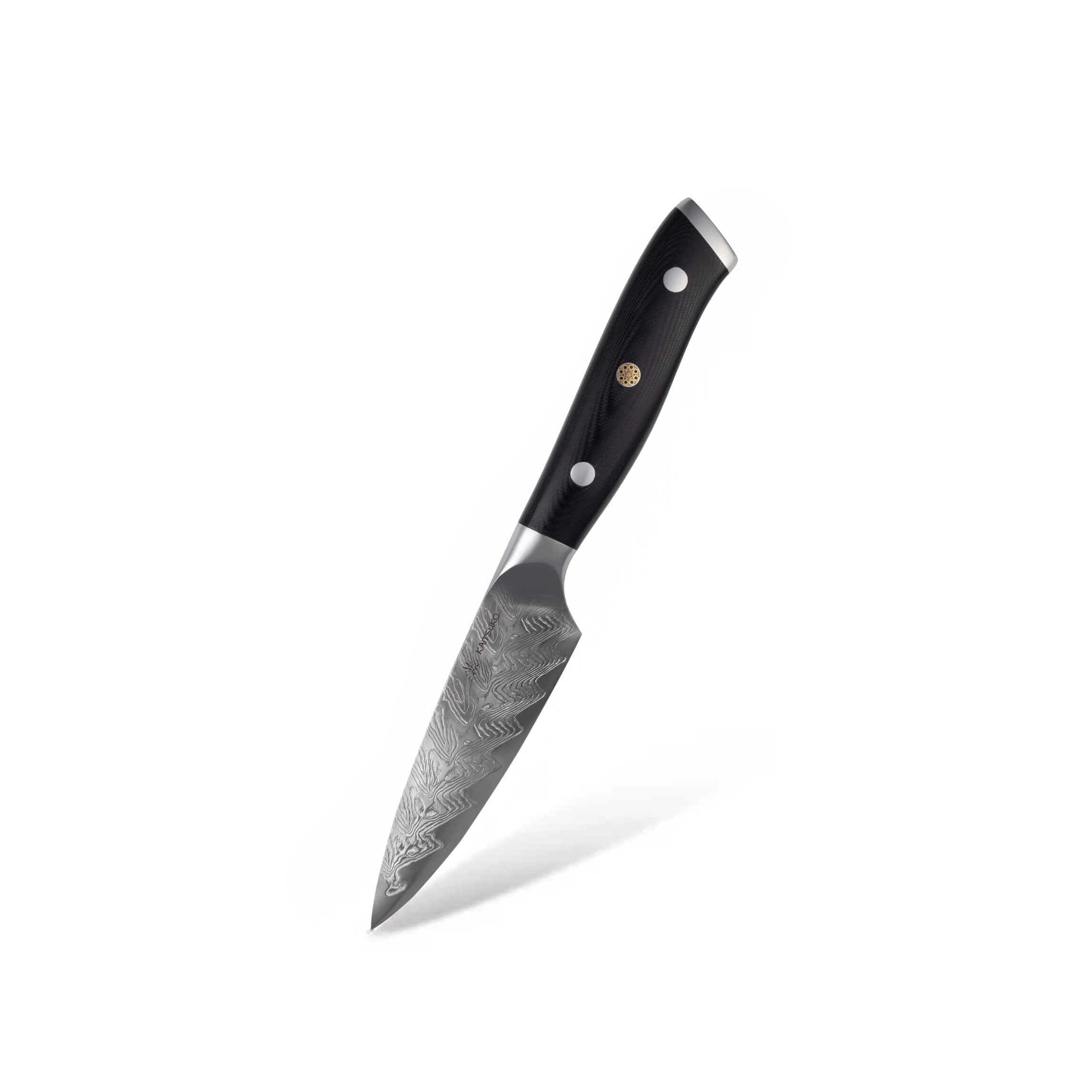
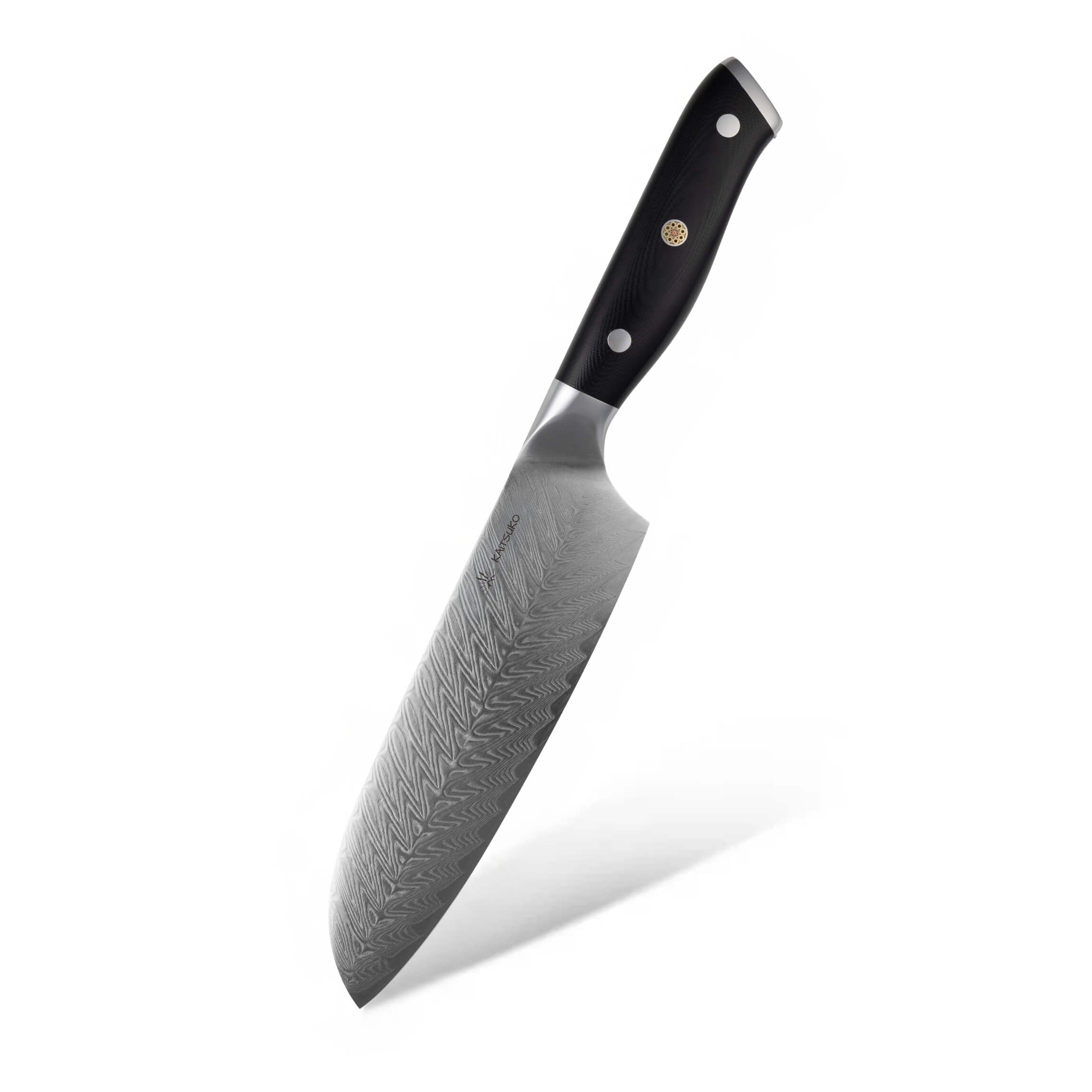
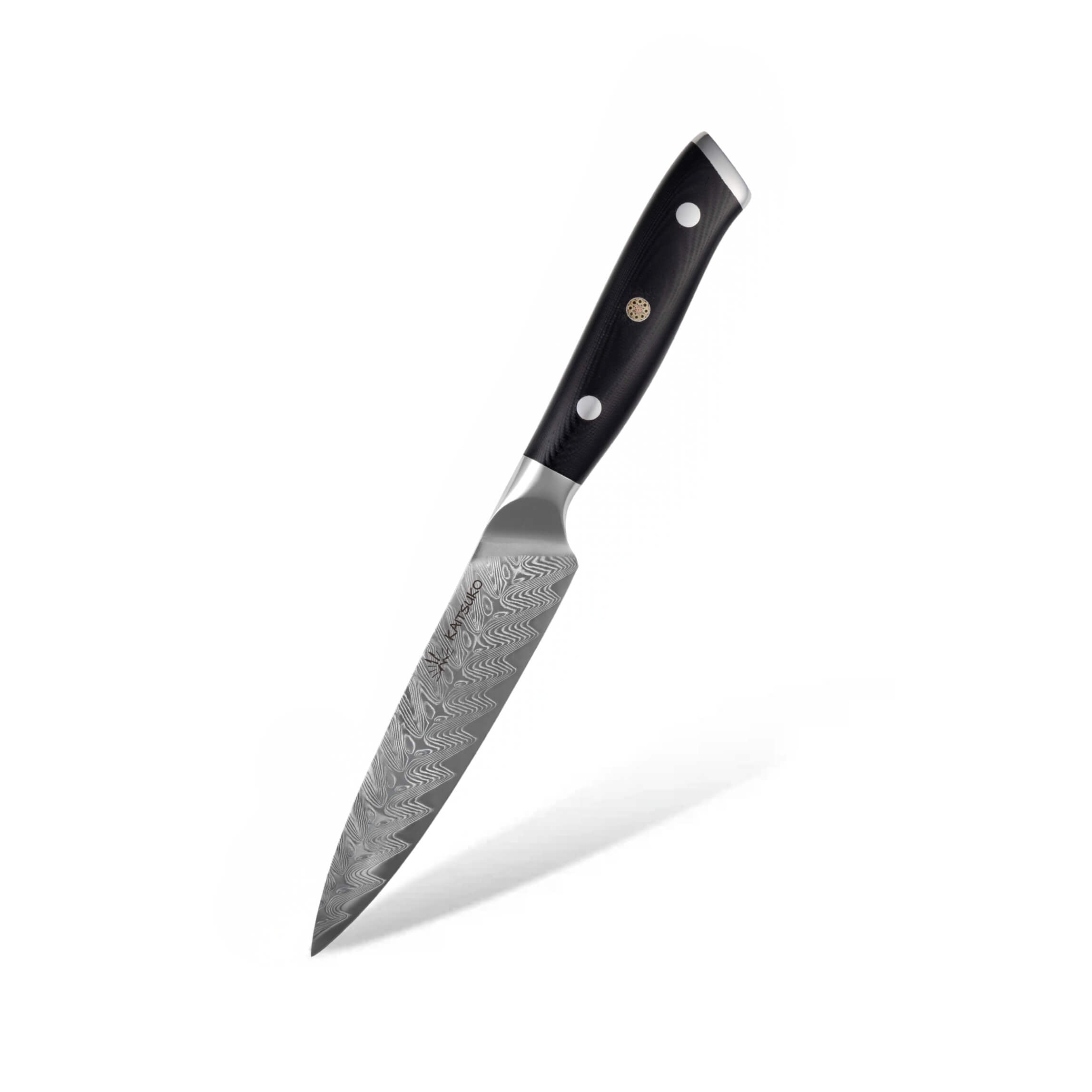

Yakumoto Japanese Knife: the Precision of Damascus Steel in Service of the Gesture
The Chef Yakumoto collection represents the pinnacle of technical standards at Kaitsuko. Designed for professional chefs and passionate enthusiasts, the Yakumoto knife is a versatile cutting tool that fuses the tradition of multi-layer forging with contemporary high-performance materials. Every blade is the result of a meticulous process aimed at delivering exceptional sharpness and a durability capable of withstanding intensive use in a professional brigade or domestic kitchen.
Technical Characteristics: the Engineering of 67-Layer Damascus
The unique identity of the Yakumoto knife rests on its internal structure and the quality of the alloys selected for its manufacture.
- The blade uses the San Mai technique with a core of 10CR15CoMoV steel (rich in carbon and cobalt), forged between 67 layers of Damascus stainless steel.
- This complex forging achieves a hardness of 60±2 HRC. The addition of cobalt reinforces wear resistance, while the outer layers protect the hard core against oxidation and mechanical impacts.
- The G10 handle (high-pressure fiberglass composite) ensures total moisture resistance and exemplary dimensional stability.
- The Yakumoto knife is a lasting investment. Its ability to maintain a 15° sharpening angle without premature dulling places it among the most high-performing tools in our catalog.
Remarkable Versatility for All Types of Cuts
The Yakumoto collection was designed to cover all kitchen tasks, thanks to its different blade profiles adapted to each use.
- Meat and fish cutting: The long models in the collection allow precise and fluid work, whether slicing, trimming or filleting.
- Fine chopping and slicing: The wider, balanced blades facilitate rocking motions, ideal for quick fine slicing, dicing or chopping.
- Precision work: The more compact formats offer excellent control for meticulous cuts such as dicing, garnishing or working with small ingredients.
The Yakumoto Collection: from Paring Knife to Professional Set
To guarantee technical consistency on your work surface, the professional Yakumoto series comes in several models and assortments:
- Yakumoto Chef's Knife: The universal tool for 90% of tasks.
- Yakumoto Santoku Knife: The Japanese alternative with a taller blade, ideal for vegetables.
- Yakumoto Paring Knife: With its short blade (8 to 12 cm), it is the expert for delicate tasks: peeling, trimming and sculpting fruit and vegetables with exceptional maneuverability.
- Yakumoto Utility Knife: The indispensable complement between the paring knife and the chef's knife. Its 10 to 15 cm blade offers the finesse needed for vegetables and the robustness to prepare meat and fish.
- Yakumoto Boning Knife: Ideal for scraping all the meat from bones, cutting small bones, butchering game and poultry, and removing excess sinew and fat from your various cuts.
- Knife sets: Available in 2, 3 and 5-knife sets, often including a Santoku, chef's knife or paring knife to cover all the needs of a high-end kitchen.
Care and Maintenance: Guaranteeing a Lasting Investment
The superior quality of 10CR15CoMoV steel requires a maintenance discipline to preserve its cutting properties.
- Washing and drying: Dishwashers are strictly forbidden. Use a soft sponge with soapy water, then dry immediately to prevent any risk of corrosion.
- Sharpening: We recommend regular sharpening with a whetstone (1000/3000 grit) to respect the 15° angle. The use of a honing steel can be useful for daily edge maintenance.
- Storage: To prevent Damascus patterns from knocking against each other, store your tools in a knife block, on a magnetic holder or use an individual blade guard. A transport bag is recommended for mobile cooks.
Why Choose the Yakumoto Chef's Knife at Kaitsuko?
By choosing Kaitsuko, you opt for rigorous technical know-how. Although our manufacturing is located in Asia to guarantee a competitive price-to-quality ratio, every Japanese knife in the Yakumoto range meets stringent control standards. Our team of enthusiasts ensures that every delivered blade possesses the promised visual identity and technical performance. Whether you are a chef in a high-end restaurant or a demanding amateur, the Yakumoto collection is designed to elevate your culinary experience.
Expert FAQ: Everything About the Yakumoto Series
What makes the Yakumoto chef's knife unique?
It is the alliance between a 10CR15CoMoV steel core at 60±2 HRC and an Onyx black handle, Carbon Gold handle or White Stone handle, ergonomic in G10. This combination offers exceptional edge retention while guaranteeing a stable grip, even in wet environments.
How to choose between the Yakumoto chef's knife and Santoku knife?
The chef's knife is preferred for its amplitude and rocking motion on proteins. The Santoku, with its shorter and straighter blade, is often preferred by those who work predominantly with vegetables and seek more lightness.
What accessories are recommended to accompany my Yakumoto?
A wooden cutting board is essential to avoid dulling the steel. We also recommend acquiring a quality whetstone and an elegant storage block to protect the 67 layers of Damascus steel.
Is it possible to buy the Yakumoto collection wholesale?
Yes, Kaitsuko offers flexible conditions for the B2B market via the Ankorstore platform, allowing specialized stores and restaurants to equip their brigades with our superior quality tools.
What is the value for money of the Yakumoto chef's knife?
The value for money of the Yakumoto series rests on the integration of 10CR15CoMoV steel treated at 58-60 HRC. Where standard industrial blades dull quickly, we offer a San Mai structure where 67 steel layers protect a high-carbon core (1.05%). In use, the cutting sensation is marked by fluid penetration into fibers, as the addition of cobalt in the alloy improves the fineness of the edge and its resistance to mechanical wear. We consider this tool a strategic investment: its ability to maintain a 15° bevel twice as long as a classic steel recoups its acquisition cost through exceptional durability.
How to choose between the Yakumoto chef's knife and utility knife?
The choice between these two profiles is dictated by the amplitude of your gesture and the nature of the food being processed. The chef's knife is a volume tool, with a long and tall blade enabling the rocking motion essential for chopping and cutting dense proteins. The utility knife stands out for its short and narrow blade, ideal for precision work or off-board cuts.
At 259 g, the Yakumoto chef's knife offers a handle-to-blade balance that reduces effort during repetitive tasks, while the utility knife prioritizes tip agility. We recommend the chef's knife as the versatile pillar of your kitchen, and the utility knife as a complement for finishing work or small ingredients.
Technical Comparison: the Yakumoto Chef's Knife Against Cutlery Standards
The choice of a chef's knife should not rest on aesthetics, but on the match between the steel mechanics and your daily use. Here is how the Yakumoto series positions itself against the other pillars of the Kaitsuko range and market standards.
Chef Yakumoto vs Tanaka: pure performance against robustness
- Technical note: The Yakumoto uses 10CR15CoMoV carbon steel at 58-60 HRC, while the Tanaka relies on 5CR15MoV (53-54 HRC).
- Knowledge: The Tanaka collection is designed for resilience; its steel is "softer", making it less prone to chipping under impact and much simpler to sharpen for a beginner. The Yakumoto, with its cobalt-enriched core, prioritizes edge retention.
- Performance analysis: In hand, the Yakumoto (259 g) offers superior inertia to the Tanaka, facilitating the cutting of dense pieces. The Yakumoto's edge stays "razor-sharp" twice as long.
- Expert verdict: Choose the Tanaka for unconstrained use and easy maintenance. Opt for the Yakumoto if you already master stone sharpening and are seeking lasting surgical precision.
Chef Yakumoto vs Kyoto: two visions of the premium segment
- Technical note: The Yakumoto stands out with its 3 available colors and its 67-layer Damascus structure, where the Kyoto series bets on a more traditional design.
- Knowledge: G10 is an unrottable composite material, offering thermal and mechanical resistance superior to the pakka wood often used on other ranges. It is ideal for very humid professional kitchen environments.
- Performance analysis: The Yakumoto has a thicker blade at the back that tapers progressively toward the tip. This balance shifts the center of gravity, offering reassuring stability during rocking motions.
- Expert verdict: The Kyoto is the choice of classic elegance. The Yakumoto is the choice of the chef seeking a "tactical" tool, capable of withstanding intensive service thanks to its ultra-resistant handle.
Chef Yakumoto vs Standard Western Chef's Knives
- Technical note: A classic Western chef's knife often displays an angle of 20° with a hardness of 55 HRC. The Yakumoto chef's knife imposes an angle of 15° for a hardness of 60 HRC.
- Knowledge: 10CR15CoMoV steel allows a much finer blade to be maintained without it bending. The San Mai structure of the Yakumoto (hard core between two protective flanks) is a technique absent from most Western industrial production.
- Performance analysis: Where a standard knife "crushes" food cells (rapid oxidation of herbs, loss of meat juices), the Yakumoto cleanly sections the fibers, preserving the organoleptic qualities of the products.
- Expert verdict: Switching to the Yakumoto requires an adjustment period: its lightness and extreme sharpness radically change the perception of effort. It is a tool that serves the gesture, where the Western knife often demands compensation through force.
Maintenance reminder: To preserve the integrity of 10CR15CoMoV steel, the use of dishwashers is strictly prohibited. Hand washing followed by immediate drying is the only guarantee of longevity for your 67 Damascus layers.