



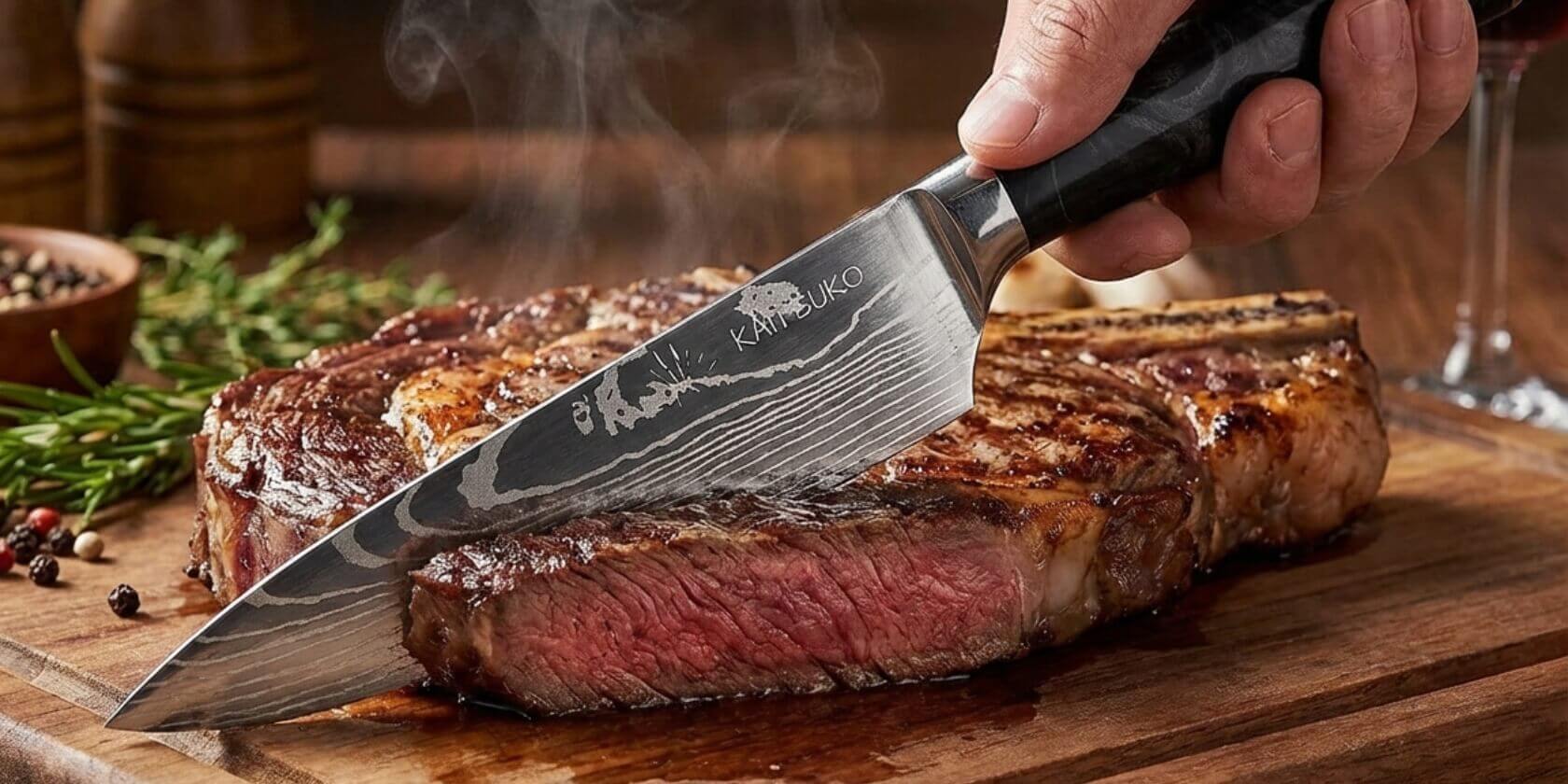
When you use a quality Japanese knife for the first time, the reaction is often the same. The blade seems to glide through food almost effortlessly. An onion splits in two with a clean stroke, a tomato slices without being crushed, and even the most delicate herbs stay intact after cutting. Many cooks have this strange impression that the knife "does the work itself."
This feeling is no coincidence. The difference between Japanese and Western knives comes from a set of technical choices that directly influence how the blade interacts with food: the thinness of the blade, the sharpening angle, the type of steel used, and the very philosophy of manufacture. Once you understand these elements, you realise that this exceptional cutting sensation is the result of a very precise balance.
The first thing you notice about a Japanese knife is the fineness of the blade. Compared to traditional Western knives, Japanese blades are often thinner and lighter. This difference may seem minimal, but it changes everything when cutting. A thin blade meets less resistance as it enters food. Instead of pushing or crushing the fibres, it passes through them more easily. This produces very clean cuts, particularly with vegetables, herbs, or fish. In Japanese cuisine, this precision is essential, as the presentation and texture of ingredients play just as important a role as their flavour.
Another key element is the sharpening angle. Western knives are typically sharpened at an angle of between eighteen and twenty-two degrees. Japanese knives, on the other hand, are often sharpened between ten and fifteen degrees. This difference may seem small on paper, but it completely transforms how the blade behaves. The finer the angle, the more precise the edge. The blade then acts almost like a culinary scalpel, capable of making extremely clean cuts. This is why some chefs can slice fish into almost translucent pieces or make very fine cuts in vegetables without damaging them.
Of course, this very precise angle would not be possible without the right steel. One of the secrets of Japanese knives lies precisely in the composition of their steel. Many high-end blades use high-carbon steels. Carbon increases the hardness of the metal after heat treatment, making it possible to achieve a finer, more durable edge. A harder blade can hold its edge longer and be sharpened with remarkable precision. This is one of the reasons why Japanese knives can remain exceptionally sharp for a long time when properly maintained.
In the most premium models, this performance is further enhanced through the use of Damascus steel structures. Unlike simple steel, Damascus steel is made up of multiple layers of different steels forged together. This process creates the famous wavy patterns visible on the blade, but it also offers a technical advantage. The core of the blade is generally made of a very hard, high-carbon steel responsible for the edge. The outer layers, slightly softer, absorb stress and reinforce the overall strength of the blade. This combination produces a remarkable balance between cutting performance and resilience.
At Kaitsuko, we often see the same scene when someone discovers a well-sharpened Damascus blade. There's always a moment when someone grabs a sheet of paper to test the edge. It's not the most scientific method in the world, but it's a small ritual that keeps coming back. And it has to be said: when the blade glides through the paper without resistance, you immediately understand why these knives have such a reputation.
But the difference between Japanese and Western knives is not limited to technique. It also rests on a different vision of cooking. In Japanese tradition, cutting ingredients is considered a fundamental step. The way a food is cut influences its texture, how it cooks, and even how its flavours are perceived. This attention to cutting explains why the knives are designed to offer maximum precision. Every detail of the blade is thought out to facilitate a clean, controlled cut.
This approach also explains why Japanese knives sometimes require a little more care. A very fine and very hard blade must be used correctly. Surfaces that are too hard, such as glass or ceramic, can damage the edge. Similarly, it is better to wash these knives by hand and dry them immediately. But these habits quickly become second nature for anyone who appreciates cooking with good tools.
Over time, many cooks end up developing a real relationship with their knife. A well-maintained blade can accompany its owner for many years. It bears the marks of its use — sometimes a light patina — and becomes almost a natural extension of the movement in the kitchen. Perhaps that, at heart, is the real reason why Japanese knives fascinate so many people. They are not just tools. They are the result of a tradition, a craft, and a constant pursuit of precision.
And once you get used to this quality of cut, going back often becomes very difficult.
The Essential Knives for a Professional Kitchen: The Restaurant Owner's Guide (2026)